


Popular articles
- What Is Rivals of Aether? Game Type, Platforms, and Modes Explained
- Black Myth Wukong Guide – What To Expect From This Amazing New RPG
- Top 5 Gaming Thrones for a Luxurious Gaming Experience
- Is Sonic Triple Trouble 16-Bit Official? Who Is The Bad Guy in Sonic Triple Trouble?
- Among Us Original: Where and How To Play The Classic Game


Half-pipe rethink reshaped Drag x Drive’s dunks and pacing
Table of Content

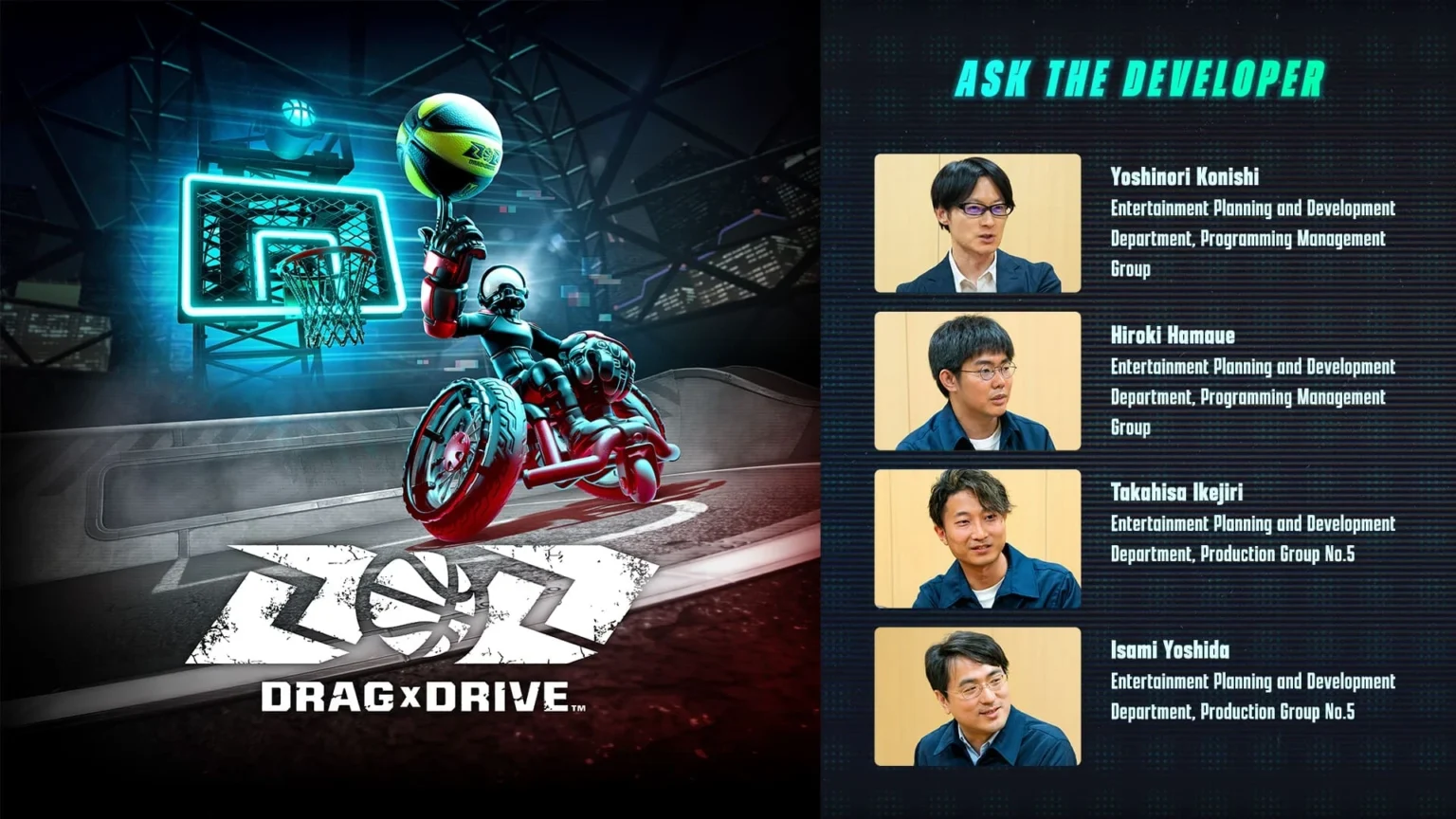
Nintendo has published Part 2 of Ask the Developer Vol. 20, focusing on how Drag x Drive – a Nintendo Switch 2 sports title released on Thursday, August 14, 2025 – found its defining mechanic. The team explains how an under-hoop half-pipe emerged as the answer to multiple design hurdles. The interview also expands on the game’s analog-first control philosophy, constant-flow rules, and the trio of character types that shape team strategy. Developers discuss what made the movement click, why dunking needed a rethink, and how visual and audio cues reinforce readability.
Below are the key takeaways, distilled from the official developer conversation.

Analog feel first: movement that maps to real actions
The team pursued controls that feel “analog” – inputs that mirror plausible real-world motions and produce clear, one-to-one responses in-game. They defined two conditions: moves should look natural in real life, and the input-to-action mapping must be obvious.

Drawing from wheelchair basketball, they implemented tilting – lifting one side to pivot – using Joy-Con 2 gestures. The team experimented with a BMX-style bunny hop concept (front then rear lift) to introduce verticality, testing quick left-right tilts to leave the ground. A short demo attempt helped the designers visualize the input and refine the idea. Video reference mentioned in the interview:
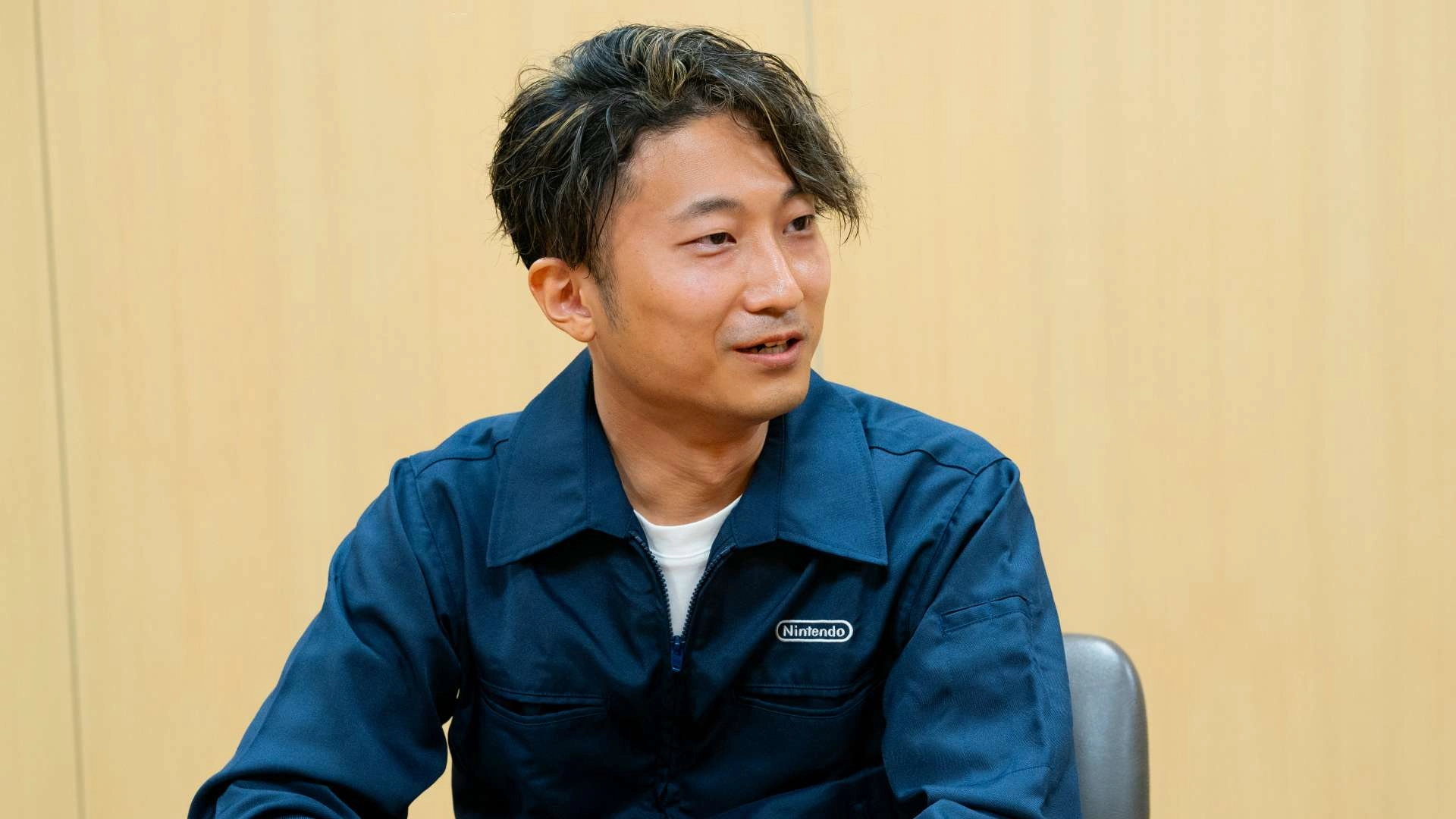
“By quickly tilting left and right, I managed to lift off the ground by about 2 millimeters.” — Konishi

That third dimension became crucial – rebounds and aerial plays gained tactical depth once hopping entered the toolkit.
One ramp, three problems solved
Placing a half-pipe beneath the basket addressed three separate design issues at once, according to the developers.
- Natural dunk inputs – Early dunking felt abrupt: move under hoop, swing up, auto-jump. The half-pipe created organic lift so a Joy-Con 2 swing near the rim could trigger a dunk that felt earned and analog rather than canned.
- Faster return to play – After shooting straight through, players had been overshooting and drifting wide. Riding up and down the half-pipe now naturally rolls the chair back toward center, reducing downtime.
- Clear character direction – Airborne action and wipeout risk pushed the team toward helmets and armor, crystallizing the look and roles of the three character types.
“Introducing the half-pipe meant players could now launch into the air, adding airborne action to matches.” — Hamaue
Play never stops: score, scramble, counter
Read also our article: Hela mixes co-op and solo play with Shades, set for 2026 launch
Drag x Drive’s matches do not reset after a score. Once the ball drops, play continues, encouraging immediate fast breaks and quick defensive rotations. That nonstop tempo raises urgency and helps the half-pipe’s return-to-center effect shine.
“Even if the other team scores, you can grab the ball right away and launch a fast break.” — Ikejiri

Three character types, one top speed
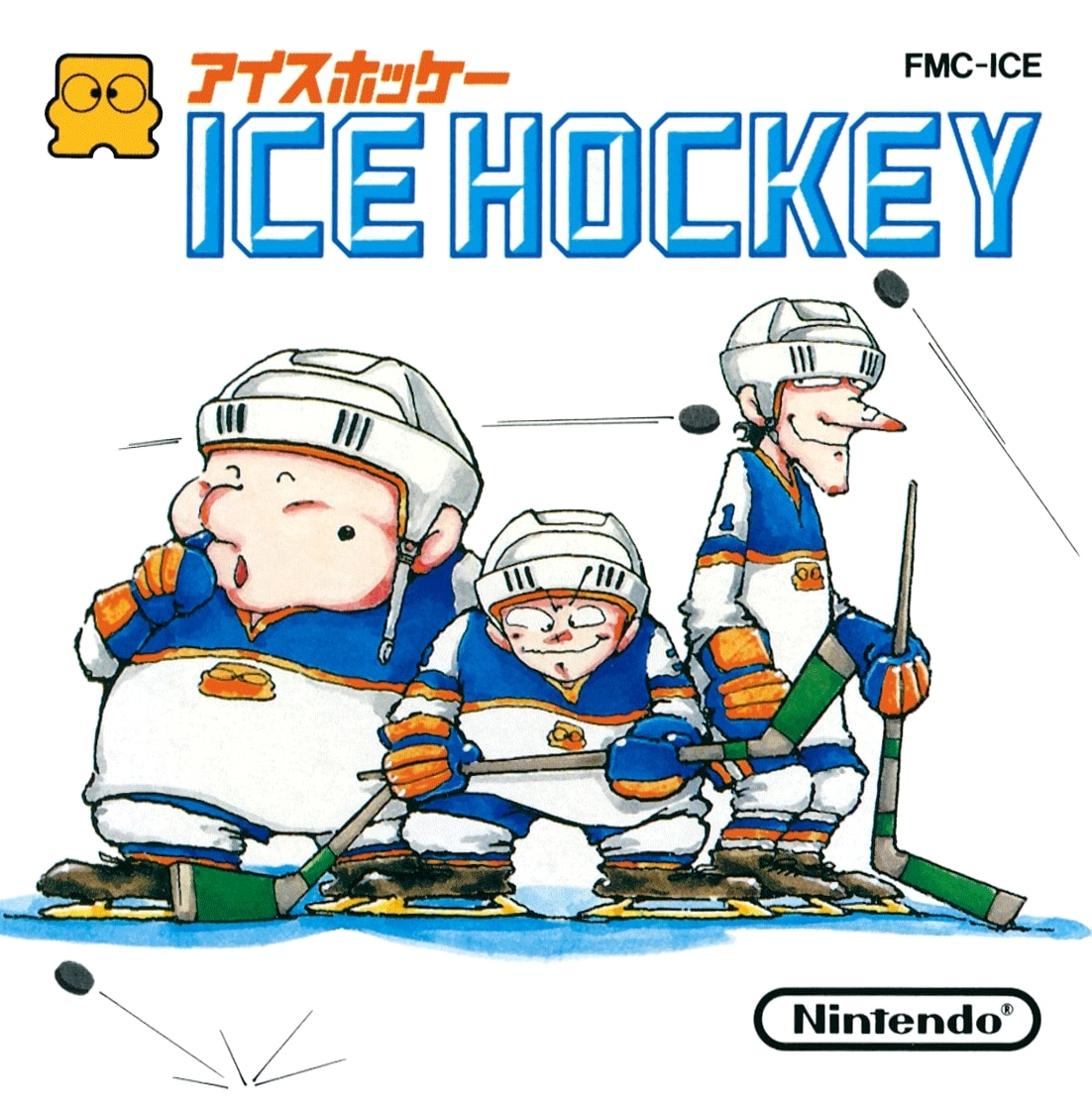
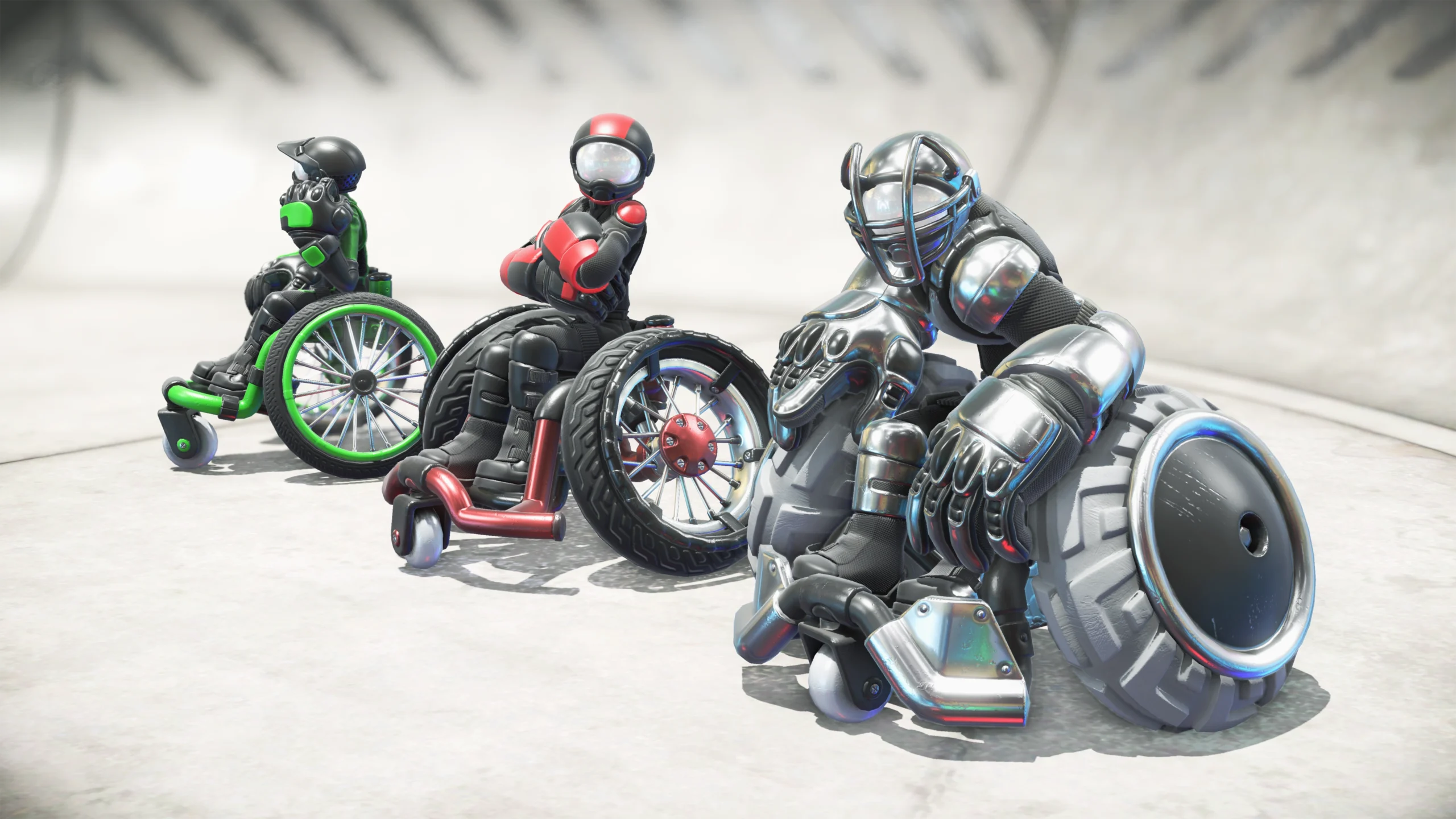
The roster is built around three archetypes – Guard, Forward, Center – a nod to the formation logic popularized by classics like Ice Hockey (Famicom Disk System, 1988). Rather than “light-fast vs heavy-slow,” all types share the same top speed, while differing in acceleration, turning, mass, and role.
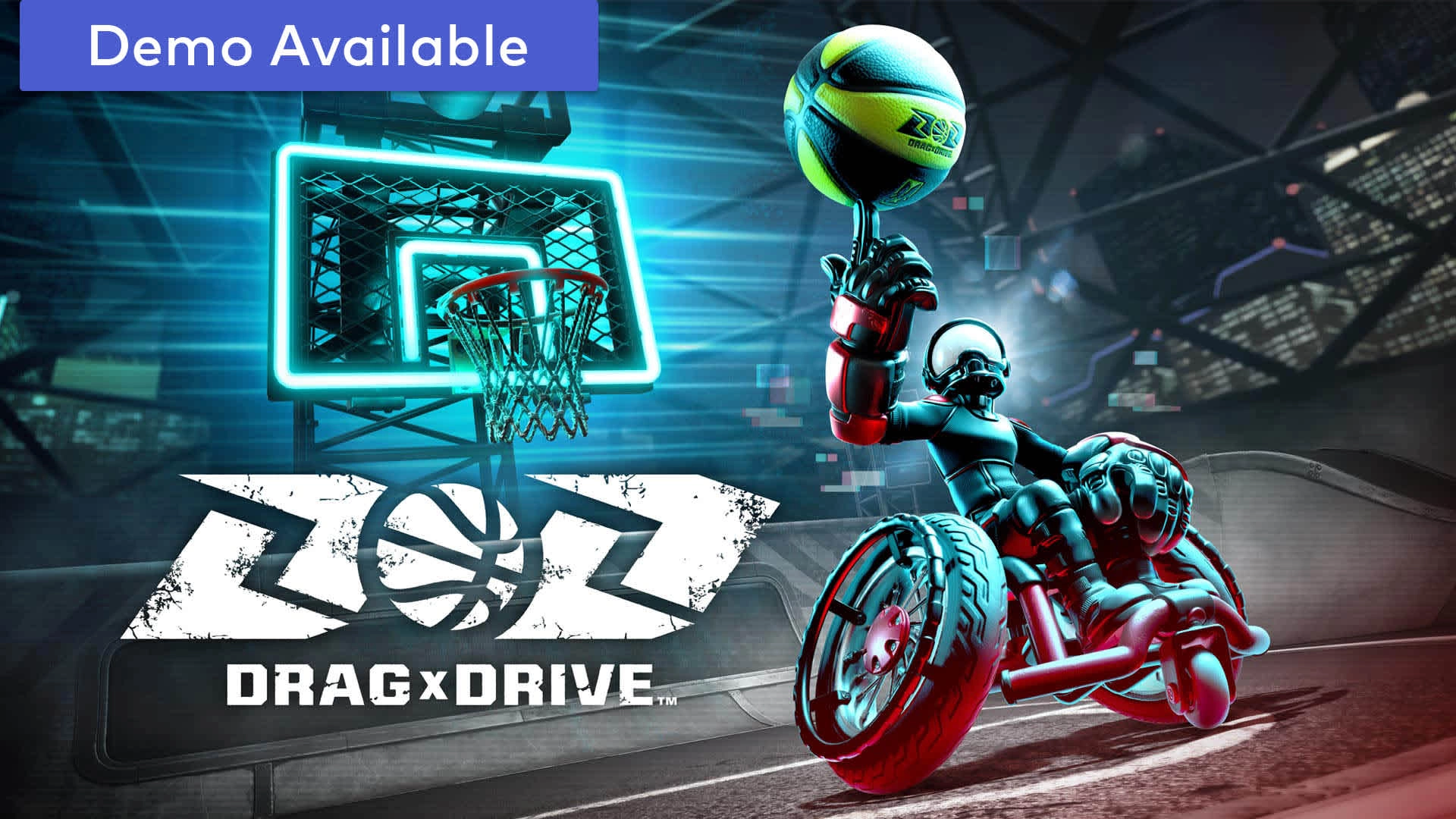
Design cues borrow from real sports wheelchairs: the Center includes a rugby-style bumper for bruising play; the Forward draws from wheelchair basketball for balance; the Guard channels wheelchair motocross for agility. Sound design nudges readability too – landing thumps scale with character weight to make jumps feel grounded and distinct.
Table: Character roles and visual cues at a glance
The table below summarizes the intended feel and look of each type to aid quick recognition during 3-5 player scrums.
Style points that actually matter
To reconcile win-first and showmanship-first mindsets, the developers added a trick-shot bonus that scales with difficulty. Flashy plays now have tangible value on the scoreboard, reducing friction between teammates who prioritize safe 2-pointers and those pushing aerial flair.
“Trick shots with bonus points can affect the outcome of a game.” — Konishi
Final takeaway – Why this pivot matters
The half-pipe is more than set dressing – it’s the keystone that unified Drag x Drive’s input feel, pacing, and identity. For players, that means analog gestures translate into satisfying elevation, a rhythm that never stalls after scores, and a roster where roles are readable at a glance. If you thrive on momentum and expressive movement, Part 2 of the dev series makes one thing clear: the ramp made the sport.




Meet the Author



Article:
Read all


Solid Snake joins Rainbow Six Siege on March 3. Expect an intel-focused gadget, on-the-fly scavenging, a stealthy 4v4 event with Sam Fisher, and updates across maps and Operators.
 February 15, 2026
 85
85
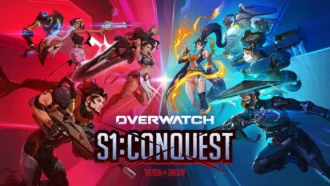
A year-long Overwatch narrative lands on Switch. Season 1 opens the Reign of Talon, adds 5 heroes, and introduces a 5-week faction event—setting the stage for updates through Season 6 in 2026.
February 14, 2026
82
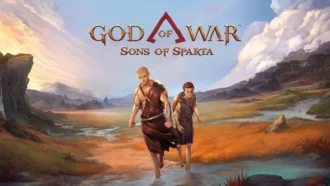
A new chapter in Kratos’ past arrives on PS5. Sons of Sparta shifts the series to 2D, exploring the Agoge with Deimos, classic Greek foes, skill trees, and Gifts of Olympus – all scored by Bear McCreary.
February 13, 2026
79

Assassin’s Creed Origins steps into the museum space as Ubisoft and the Musée de l’Homme unveil a nine-minute interactive walkthrough of ancient Egyptian embalming, part of the Mummies exhibition running November 2025 - May 2026.
February 13, 2026
76
Subscribe to “By-Gamers” on Telegram for gaming intel.
No filler, no fuss—just your daily XP boost. Hop in and level up, squad!


Read also
Solid Snake joins Rainbow Six Siege on March 3. Expect an intel-focused gadget, on-the-fly scavenging, a stealthy 4v4 event with Sam Fisher, and updates across maps and Operators.
February 15, 2026
85
A year-long Overwatch narrative lands on Switch. Season 1 opens the Reign of Talon, adds 5 heroes, and introduces a 5-week faction event—setting the stage for updates through Season 6 in 2026.
February 14, 2026
82
A new chapter in Kratos’ past arrives on PS5. Sons of Sparta shifts the series to 2D, exploring the Agoge with Deimos, classic Greek foes, skill trees, and Gifts of Olympus – all scored by Bear McCreary.
February 13, 2026
79
Assassin’s Creed Origins steps into the museum space as Ubisoft and the Musée de l’Homme unveil a nine-minute interactive walkthrough of ancient Egyptian embalming, part of the Mummies exhibition running November 2025 - May 2026.
February 13, 2026
76

High On Life 2 is out now, and its writers say the best gags start with the team cracking up first — then shaping bits so players help drive the punchlines. Here’s how Squanch approaches humor-by-design.
February 13, 2026
61
Rainbow Six Siege’s competitive year ends in Paris with a new twist: 1V1 NOW by Xbox Game Pass. Four regional standouts, 3.2k sign-ups behind them, clash Feb 14-15 for a share of $5,000 on the SI stage.
February 13, 2026
70
Fourteen Xbox titles arrive February 17-20 – from Star Trek: Voyager’s survival strategy to stealth in Styx and horror in Backrooms. Dates, platform notes, and core gameplay features inside.
February 13, 2026
63
Rayman’s 1995 debut returns in a multi-version package – with a first-ever playable SNES prototype, 120 bonus stages, a reimagined Christophe Héral soundtrack, and modern assists like a 60-second rewind.
February 13, 2026
62
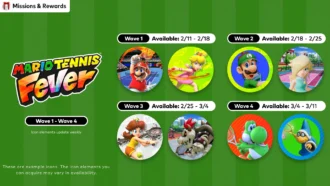
Mario Tennis Fever icon elements arrive on a ticking schedule—four waves across February-March 2026. Here are the exact PT dates, how to access them, and what the game brings to the court.
February 13, 2026
68
Nintendo serves up Mario Tennis Fever on Switch 2 with its biggest roster yet, 30 new Fever Rackets that twist rallies in wild ways, and a baby-themed Adventure Mode. Check the official trailer link inside.
February 13, 2026
67

Співпраця
Співпраця - текст
By-Gamers Newsletter!
Unlock special gaming deals, limited-time bundles, and more - sign up for By-gamers newsletter today!
